Heungdeok Dream Women's Clinic Doctor's Column
Obstetrics & Gynecology Column

Considering Menopausal Hormone Therapy: How Do You Weigh the Risks and Benefits?

The benefits and risks of menopausal hormone therapy, and who it suits, set out to help with the decision.

Published 2026-10-09 Updated 2026-10-09 Reviewed by Soojin Han, Medical Director · Obstetrics & Gynecology Specialist

Menopausal hormone therapy is neither always dangerous nor always safe. The balance of benefit and risk changes with a woman's age, the time since menopause and her medical history.

When symptoms such as hot flushes, poor sleep and vaginal dryness make daily life difficult, the benefit of replacing hormones often outweighs the concern about side effects.

This article explains when treatment is actively recommended, when more caution is needed, and the common misunderstandings about breast cancer risk.

01

Can menopausal hormone therapy be recommended to every woman in the same way?

Key point
No. It is actively recommended only for women under 60 who are within 10 years of menopause and have no serious contraindicated medical history. When those conditions differ, the approach and the decision on whether to prescribe at all change completely as well.

Menopausal symptoms begin with a shortage of female hormones, so treatment that replaces the missing hormones tends to work clearly. The Korean Society of Menopause has published evidence showing improvement in hot flushes, sleep problems and vaginal dryness, and the more severe the symptoms, the more a woman's quality of life often changes.

However, the timing of menopause, age, other conditions, and the level of risk for high cholesterol or osteoporosis differ completely from one person to the next. No medicine is entirely free of risk, so the right candidate, the right timing, and the right ingredients and dose need to be matched carefully to reduce risk and make the most of the benefit.

  • Age — the balance between benefit and safety is known to be most favourable under 60
  • Time since menopause — within 10 years of menopause the blood vessels are still healthy, so hormone replacement offers greater benefit
  • Medical history — treatment can be actively recommended only when there is no contraindicated history such as thrombosis or breast cancer
02

Does taking hormones greatly increase the risk of breast cancer?

Key point
No. Much of the concern raised by earlier research has been corrected by later reanalyses that took age and the type of hormone into account. The combination of ingredients used in clinical practice today is also very different from what was used in the past.

The concern linking hormone therapy with breast cancer came from the results of the American WHI study. Later reanalyses that accounted for factors such as age and the type of medication showed that the risk was not as large as first reported, and the figures from that time cannot simply be applied to treatment today.

A study of long-term safety enrolled postmenopausal women aged 50 to 79, gave them hormone therapy for 5 to 7 years and analysed the outcome. It concluded that the treatment was not associated with a long-term risk of death from cancer or cardiovascular disease, which points in a different direction from the common belief that hormones should always be avoided.
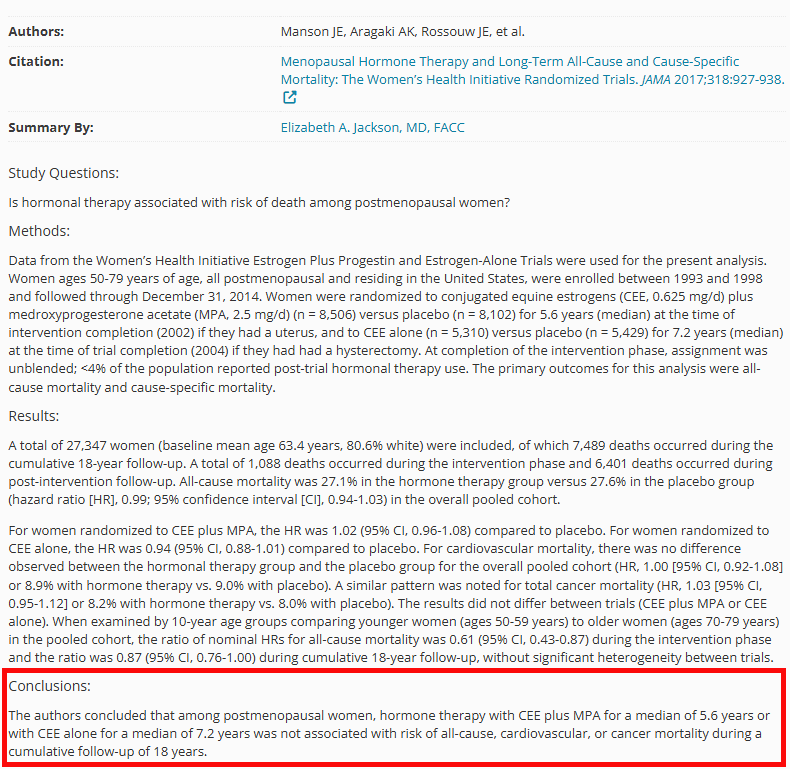
Research material related to Considering Menopausal Hormone Therapy: How Do You Weigh the Risks and Benefits?
Related research
03

Is treatment ruled out if menopause was long ago or you are older?

Key point
It is possible, but more caution is needed. For women aged 60 or older, or more than 10 years past menopause, ageing of the blood vessels may already be under way, so the risks and benefits need to be weighed again carefully before treatment starts.

Oestrogen helps suppress inflammation inside the blood vessels and protects them, but this effect holds only when the vessels are still healthy. If more than 10 years have passed since menopause, it is likely that vascular ageing has already progressed considerably.

Starting hormones late, when the vessels have already aged, can make them less stable and raise the risk of conditions such as blood clots, cardiovascular disease and stroke. Before treatment begins, other conditions and the severity of symptoms must be checked carefully.

  • Vascular ageing — when menopause was long ago, the vessels have aged and hormone treatment can become a burden
  • Clot risk — adding hormones to unstable vessels can raise the risk of blood clots
  • Heart and brain risk — the possibility of stroke or cardiovascular disease needs to be considered in the decision

Soojin Han, Medical Director
Doctor's view

How the doctor decides

Soojin Han, Medical Director · Obstetrics & Gynecology Specialist

I check the time since menopause, not just the symptoms

I look at when menopause began just as closely as at how severe the symptoms are. The same hot flushes can mean a different state of the blood vessels depending on how many years have passed since menopause, so I do not decide on a prescription without this information.

I do not simply hand over a prescription

Rather than just telling a patient to take the medicine, I first check how much the symptoms interfere with daily life, her age and the time since menopause, and whether there is any history that rules the medicine out. Only then do I decide on a prescription.

If a reaction appears, I do not leave the prescription as it is

If a patient develops reactions such as nausea or diarrhoea after starting treatment, I redesign the prescription by adjusting the form, the ingredients or the dose. If a treatment meant to improve quality of life creates new discomfort, I see no reason to leave it unchanged.

I explain the risks first rather than hiding them

I do not let patients feel a vague fear simply because the medicine is a hormone. I explain the risks and benefits known so far side by side and help them make the decision themselves. I do not settle on one answer in advance and push it.

Summary

In summary

Because the balance of benefit and risk in menopausal hormone therapy changes with age, the time since menopause and medical history, it is not a treatment that can be approached with an answer decided in advance.

For women under 60 who are within 10 years of menopause and have no serious contraindicated history, it can be actively considered. In the opposite situation, the condition of the blood vessels should be reviewed first.

If hot flushes, sleep problems or vaginal dryness are interfering with daily life, it is worth seeing a doctor to find out which approach suits you.

FAQ

Frequently asked questions

QWhat happens if side effects such as nausea or diarrhoea appear during treatment?
A

Instead of tablets, treatment can be switched to vaginal or other local preparations, or to a non-hormonal medicine. Another option is to lower the dose so the body can adjust gradually.

QUp to what age can hormone therapy be started?
A

The time since menopause and the condition of the blood vessels matter more than age itself. For women under 60 who are within 10 years of menopause it can be actively considered, but beyond that a careful review is needed.

QWhat tests are needed before starting treatment?
A

The basic checks are a blood test of hormone levels around menopause, a pelvic ultrasound of the uterus, and a mammogram. During treatment it is advisable to repeat these checks every 6 months to 1 year.

QIs long-term hormone therapy safe?
A

A study that analysed postmenopausal women aged 50 to 79 who received treatment for 5 to 7 years concluded that it was not associated with a long-term risk of death from cancer or cardiovascular disease. Even so, this result assumes an appropriate prescription that takes the right candidate and timing into account.

Soojin Han, Medical Director
Medical review
Soojin Han, Medical Director · Obstetrics & Gynecology Specialist
This content is general medical information and may not apply to every individual. Diagnosis and treatment are decided through a consultation.